Nobody is a medium: what made-to-measure actually changes
A medium is not a body. It is a statistical average of thousands of bodies, and the average of a large group of people resembles almost none of them.
5 min read
If you are a medium in one shop and a large in the next, that is not you. Nobody has to follow a size chart. The United States published a voluntary sizing standard in 1958, Commercial Standard 215-58, and withdrew even that in 1983, and there has been no mandatory clothing size standard since. Every brand now drafts its own chart on its own fit model, which is why a 10 in one shop is a 16 in another and neither of them is wrong. The deeper problem is that no chart could work anyway, because a size is an average of several measurements at once and almost nobody is average on several measurements at once. Made to measure is the alternative, and this is what it actually changes.
Ready to wear clothing is built on a size chart, and a size chart is a compromise made before anyone knew who would wear the garment. It has to be. A factory cutting five thousand shirts cannot know whose shoulders they will sit on.
The compromise works reasonably well for people near the middle of the distribution on every measurement at once, and it works badly for everyone else. Which, once you look at more than one measurement, is most people.
Why the average fits almost nobody
There is a well known finding from aviation. In 1952 a US Air Force researcher called Gilbert Daniels measured 4,063 pilots on ten dimensions and checked how many fell within the middle range on all ten at once. The answer was none. Not a small number. Zero. The Air Force's response was to ban the average outright and require adjustable cockpits instead.
Clothing has exactly the same problem. You may be a medium across the shoulders and a large through the hip. Your arms may be longer than the chart expects for your chest. Your waist to hip ratio is yours and not the chart's. Each individual measurement can be close to average while the combination is not, and a garment cut to the combination is what actually fits.
Four thousand and sixty-three pilots, measured on ten dimensions. The number who were average on all ten at once was zero.
What actually changes
The shoulder, which is the one that cannot be fixed later
A tailor can take in a waist, shorten a sleeve, adjust a hem. Almost nothing can be done about a shoulder seam sitting in the wrong place, because the whole garment hangs from it. If the shoulder is wrong the piece will never look right no matter what else is altered, which is why a garment cut to your shoulder is a different object from one that was altered to approximately fit it.
Sleeve length, separately from everything else
On a size chart, sleeve length is tied to chest size. On a person it is not. Tailors list sleeve length and taking in the back as the two alterations most often asked for on a shirt, and hemming as the most requested alteration of any kind. Neither is an alteration when the garment is cut individually in the first place. It is just the pattern.
Length, for your actual height
Pant length in particular is set for a height the chart assumed. Getting it right is the difference between a pant that looks intentional and one that looks borrowed.
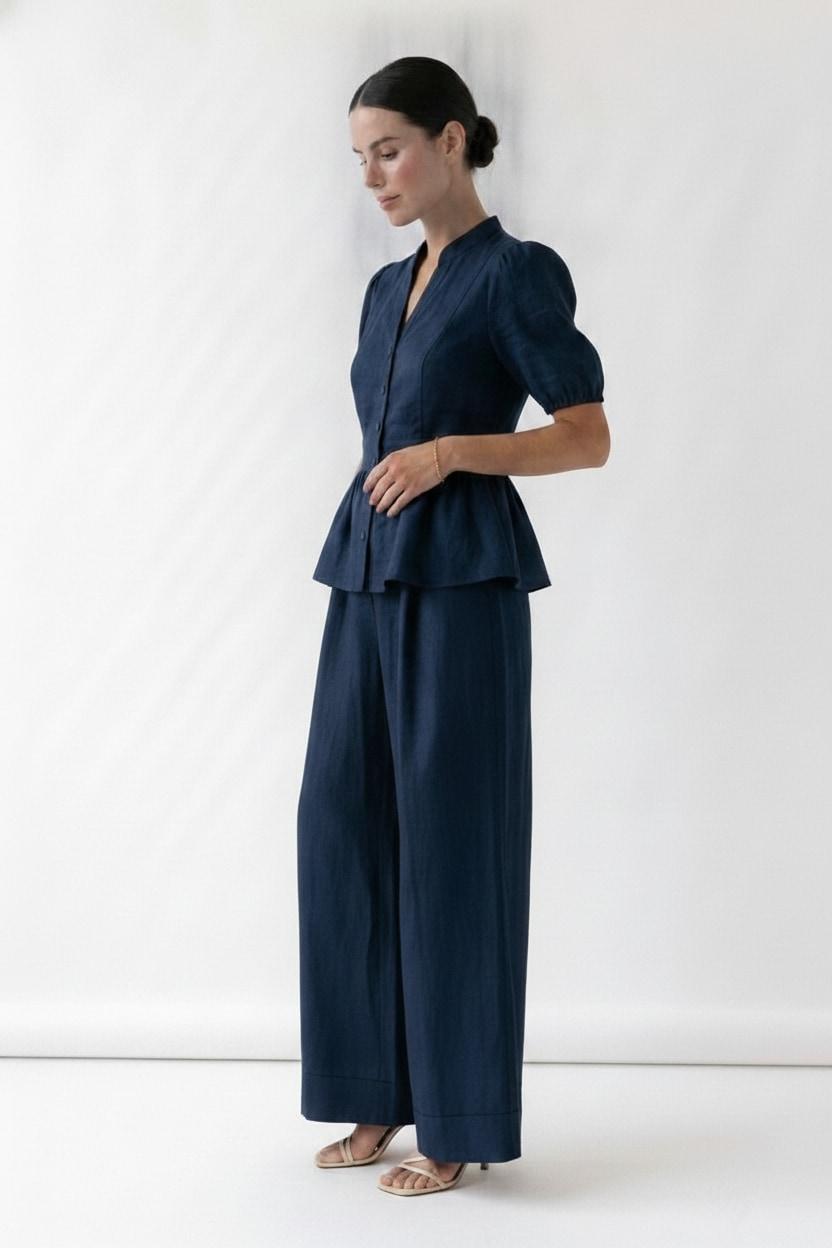
Wide leg, full length
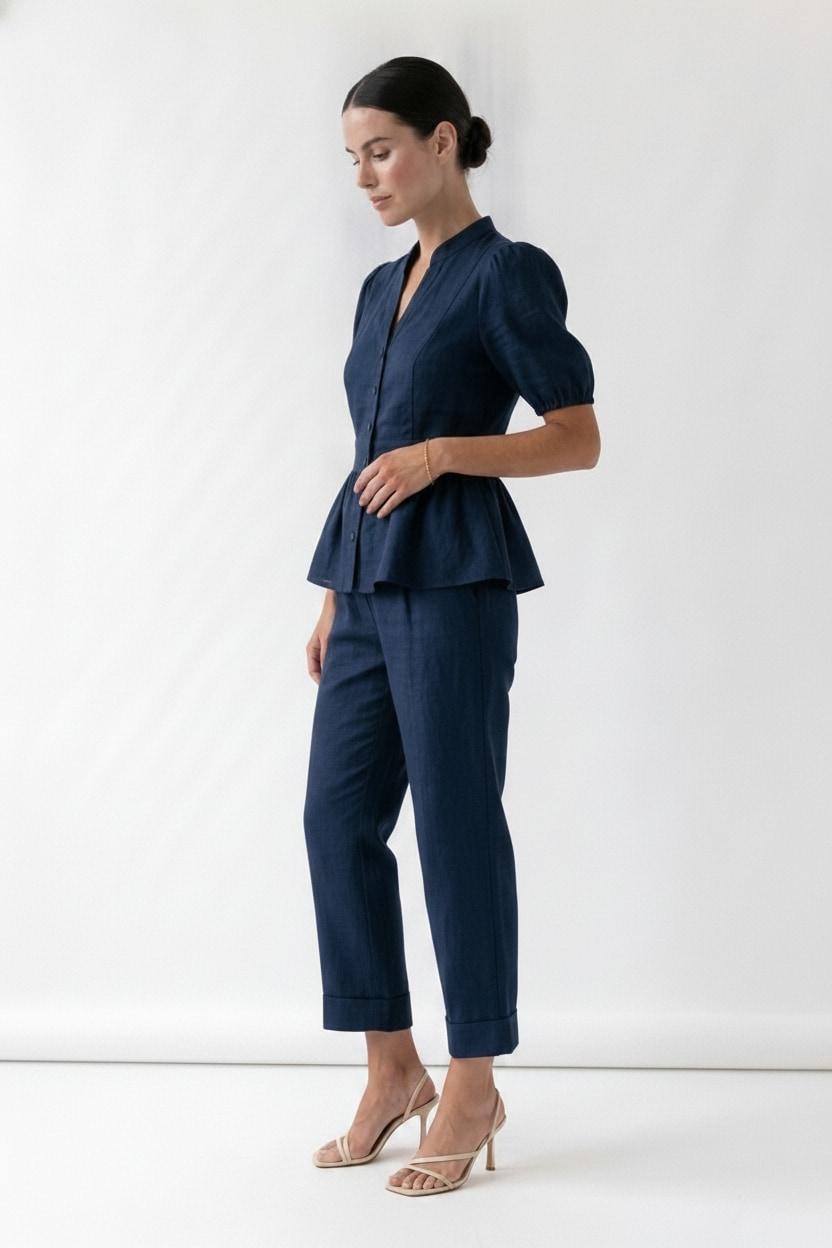
Straight leg, cropped
Same measurements, same cloth, two cuts. They do not look the same on a body, and two things decide that.
The first is where the waistband sits. The higher it sits, the more of your leg is below it, and the longer your legs look. That is the single biggest change you can make to a pant.
The second is where it stops. Your calf is the widest part of your lower leg and your ankle is the narrowest. A hem that ends at the calf cuts you off at the widest point and your legs look shorter. A hem just above the ankle does not.
That is the difference between the two above. The full-length one runs in one line from the waist to the floor, so nothing interrupts it. The cropped one stops on purpose and puts the attention on your ankle. Neither is better. They are two different garments, and off a rail you get whichever one the size run happened to be cut to.
What it does not change, and this matters
Made to measure is not magic, and brands that imply otherwise are overselling it.
- It cannot fix a design you do not like. If the cut is wrong for you, measurements will not rescue it.
- It is slower. Something made after you order it takes time to make, and anyone promising made to measure at the speed of a warehouse is not doing one of the two things.
- It depends on the measurements being right. This is the real failure point, and it is why any serious made to order brand should tell you how to measure properly and stand behind it if the fit is wrong.
- It is not the same as bespoke tailoring, where a pattern is drafted from scratch for you over multiple fittings. Made to measure adjusts an existing pattern to your numbers. It is a large improvement on standard sizing rather than a replacement for a Savile Row cutter.
Why it is possible now when it was not before
Made to order used to mean a shop, an appointment and several fittings, and it was priced accordingly. Two things changed. Measurements can now be taken in person, free on a first order. And a garment can be shown accurately on a screen before it exists, so choosing a cut no longer requires imagining it.
That combination is what makes it possible to sell a garment that was never made in advance. Nothing is cut until somebody orders it, which also means nothing is produced that nobody wanted.
What it means for buying less
The garment that gets worn is the one that was worth making. A piece that fits badly is worn twice and then avoided, which makes it expensive per wearing however cheap it was to buy. Fit is not a luxury feature. It is the thing that decides whether a garment is used or wasted.
Shaklek is made to order in the UAE. You choose the cut, the length and the colour, you see the piece as you choose it, and a tailor makes that one. Nothing sits in a warehouse waiting for a body it might fit. If you are in Dubai we come to you and take the measurements ourselves, free on your first order.
In this climate, fit and fabric are the same question: room in the right places only helps if the cloth will let sweat out. Which fibres do, with the numbers.
The place a standard size fails most visibly is pant length, and under an open abaya a pant that reaches the floor is the commonest mistake there is.
What you pay for is largely whether the garment was cut to you. This puts real numbers on that gap in one market, abayas in Dubai, from the souq rail up to made to measure.
Sources: the pilot measurements are Lt Gilbert S. Daniels, “The ‘Average Man’?”, US Air Force Wright Air Development Center, 1952. The sizing standard history, Commercial Standard 215-58 and its withdrawal in 1983, is from Seamwork and The Good Trade. The most requested alterations are from published alteration guides including Oscar Jacobson and Next Level Wardrobe. Pant rise, hem placement at the calf versus the ankle, and the unbroken colour line are from 2026 styling guides by Who What Wear, An Indigo Day, Soya Concept and Luna Fashion House.
Shaklek makes clothes to order in the UAE. You choose the cut, the length and the colour, and a tailor makes that one piece.
We are not open yet. If you are in Dubai we come to you and take your measurements ourselves, free on your first order.